Software design
We develop components, tools and digital platforms tailored to content, powerful for editors and distribution.
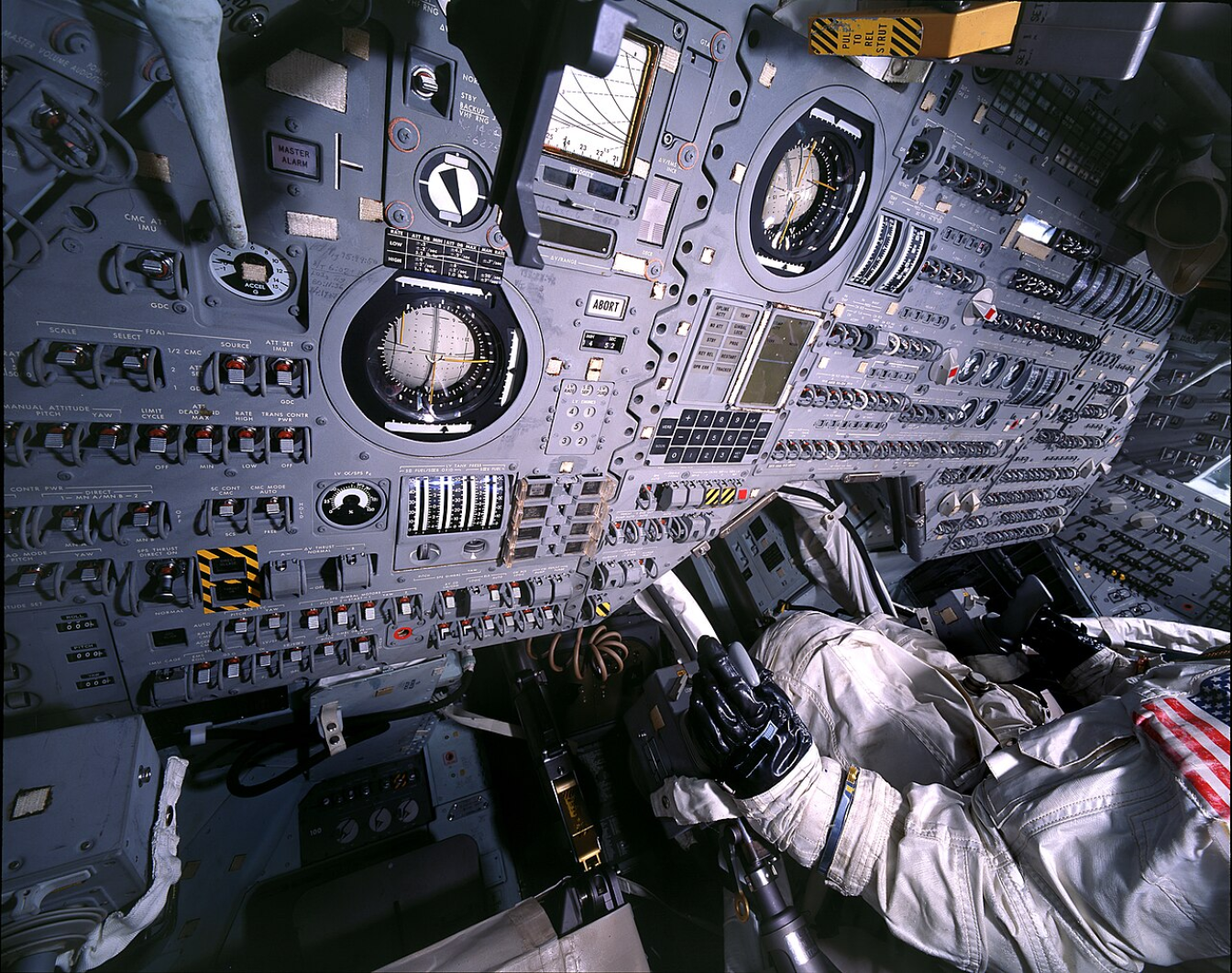
Bart Howard composed Fly Me to the Moon in 1954; Frank Sinatra sang it to the world; and Buzz Aldrin, pilot of the Apollo 11 lunar module, listened to it whilst preparing for the moon landing alongside Neil Armstrong. The journey of a song that is intertwined with aerospace engineering, calculations and military training.
Telling stories so rich in diverse content requires the very same ingredients that made these stories possible: study, technique, intuition, experimentation, time. And iterations. Doing, undoing, doing better, and flying even further.
For years we have been working on digital books, interactive exercises, infographics, accessibility tools, maps and multimedia objects of all kinds.
All this has led us to build a Component Catalogue that serves both as a guide for developers and a reference for designers and editors, reinforcing our belief that software development is a tool rather than an artefact. Armstrong and his colleagues move in and out of the demos, forging connections between components and enabling authors to find new, original ways of telling their stories using the technologies on offer.
Small and large cogs
The cogs that drive stories come in different shapes and serve different functions. A button barely the size of a palm is enough to fire up a rocket’s engines, whilst we use at least three to play a music playlist.
All components are made up of seemingly basic cogs such as buttons, text fields and control fields, yet these define the building blocks for a very broad and sophisticated user experience. For example, the ‘button’ component is responsible for optimising the handling of gestures such as clicks and taps, and for triggering the correct states – hover, active, pressed and focused – whether you’re using a mouse, keyboard or your fingers.
Thanks to the way these cogs work, we’ve been able to create components that are more complex, accessible and consistent in terms of usability.
New horizons, new media, new engines
The web continues to be enriched with formats and technologies that allow us to enjoy incredible content. Thus, the lunar module piloted by Aldrin can be compared with an illustration, or enhanced with detailed information, even in 3D. The user can scroll through the chapters of a documentary, or explore the same story outlined on a timeline of events, or immerse themselves in the lunar landscape alongside the protagonists.
We have harnessed these technologies to create components that allow this content to be displayed in a simple, customisable way that is entirely independent of back-end technologies. In addition to the UX, we have overseen the design from every angle: data structure, modularity, interoperability, workflows and editorial tools. With each iteration, the artefact of our work becomes an experience and then a tool. This is not simply a matter of reusing code, but a continuous flow of evolution for the benefit of the projects we serve.
Special, specialised and specialising components
As tools and components become available to a designer, they begin not only to create synergistic links between them, but also to build new experiences and to understand which new environments can be prototyped, developed and stress-tested.
New tools for readability and accessibility, classic teaching exercises and media for learning new languages have become fully-fledged mechanisms which, in turn, can be integrated into even larger and richer contexts.
Returning to Earth and setting off again
Bringing these components together so that they can be used in services, websites or applications has been the design and technological challenge we have set ourselves in recent years. Each of these elements is distributed as a module that can then be sold and integrated individually into a project.
In the ‘Cultura’ ecosystem created for the City of Bologna, we use geographical maps to locate events and places, compare comics with photographs, and create slideshows for image galleries. In the ‘Learning Objects’ developed for the Dante Alighieri Society and Feltrinelli Scuola, we have combined (highly) interactive exercises with specialised media such as galleries, karaoke videos and video quizzes.
The ‘like’ button we use on our websites is the same one used to submit answers to an exercise, play a video, zoom in on a map, and move to the next slide – a simple cog in an ecosystem that is growing, improving and aiming to go ever further.