
Helping blind people to perceive functional lines and geometric shapes through touch and hearing
Nicolò Carpignoli’s doctoral thesis
Nicolò Carpignoli’s (Chialab) PhD thesis (IUAV) investigates the recognition of functional lines and geometric shapes on touchscreen devices through vibrotactile feedback and speech synthesis.
In our work on educational projects, one recurring theme is making the transmission of knowledge increasingly accessible. It is within this context that the collaboration between the IUAV University of Venice and Chialab came about, culminating in Nicolò Carpignoli’s doctoral thesis, supervised by Prof. Luciano Perondi.
The transmission of content in an educational context is often accompanied and facilitated by graphical elements. Consider the visualisation of function curves, planetary orbits, graphs and geometric shapes. Their ability to aid understanding is as evident as it is inaccessible to blind and visually impaired students. Currently, the tools available to blind people are plastic sheets and embossed paper, or three-dimensional models that are difficult and costly to produce and distribute.
In recent years, several researchers have been investigating the use of digital tactile graphics on smartphones and tablets – devices that students are already familiar with and own.
It is within this context that this doctoral thesis was developed, in which a system was investigated and prototyped that redefines the production and distribution chain for digital vibrotactile figures whilst simultaneously improving their usability.
Putting the user at the centre: from needs to testing
The research project began with a careful needs analysis carried out in collaboration with the ‘Istituto dei Ciechi Cavazza’ in Bologna, which enabled us to explore the broad topic of accessibility in an educational setting, engaging with visually impaired students and their instructors and teachers. This collaboration also gave us the opportunity to identify issues arising from the real-world learning context and to approach the project by always placing the user at the centre. The students expressed their needs, developed suggestions and innovative solutions, which we incorporated and tested in the form of prototypes.
Digital vibrotactile figures
Building on the experience gained and the scientific findings of this research, we designed a software ecosystem to overcome the limitations of raised-relief tactile figures – the analogue solution currently most widely used in schools to explore graphic elements for blind and partially sighted people. The techniques were evaluated using software developed at Chialab, based on user preference, the accuracy of curve recognition and the time taken to explore them, with a sample of 12 users with visual impairments aged between 19 and 33.
Tiresia
The publishing system, Tiresia, is a digital solution comprising three software programmes that enable the cataloguing and creation of digital tactile figures in file format, which can then be explored by students on smartphones and tablets. The software has been developed in accordance with the WCAG accessibility guidelines used for websites, to enable users to use the app completely independently.
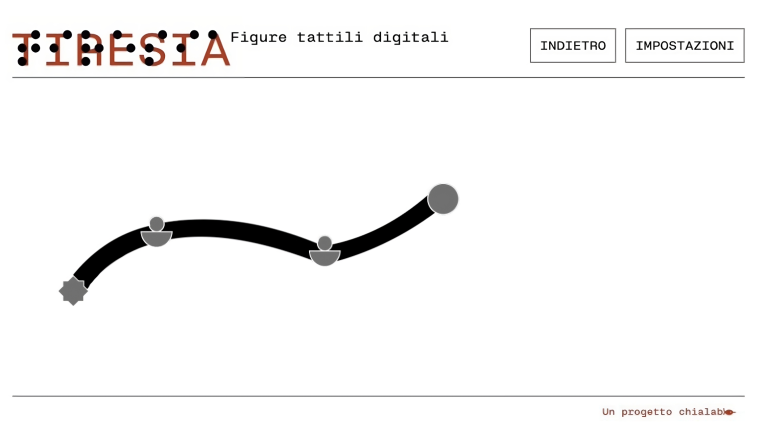
The software is customisable by users and is compatible with accessibility tools available on smartphones and tablets, such as TalkBack for Android devices and VoiceOver on iPhones. The figures are always visible on screen, allowing blind users and sighted tutors or teachers to collaborate during the learning and assessment phases.
Nicolò Carpignoli
IUAV University of Venice
Industrial PhD Programme, Chialab s.r.l.
Department of Architecture, City and Design
Research area: Design Sciences, 36th Cohort
Supervisor: Prof. Luciano Perondi
Website
www.tiresia.app
Contact details
nicolo.carpignoli@chialab.it
Read the full thesis:
AirIuav
ResearchGate